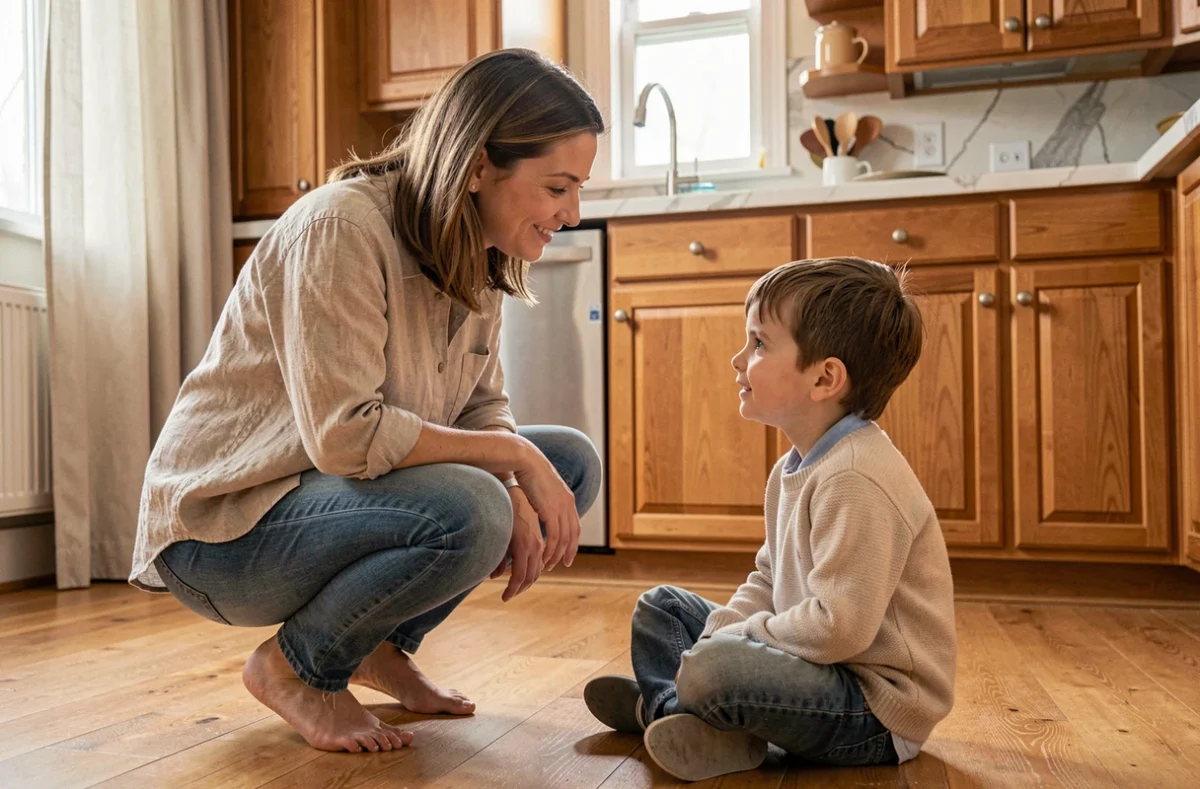
Positive education refers to an educational method based on listening, mutual respect, and setting boundaries without resorting to physical or psychological violence. Since the law of July 10, 2019, Article 371-1 of the Civil Code stipulates that parental authority is exercised without physical or psychological violence. Applying this approach in daily life requires concrete, repeated actions that are adapted to the child’s age.
1. Name the child’s emotion before correcting behavior
When a child hits or screams, the first useful reaction is to put words to what they are feeling: anger, frustration, fear. This step of verbalizing emotions helps them identify what is happening inside, which gradually decreases the intensity of the reaction.
Stating “you are angry because your brother took your toy” does not excuse the action. It sets a framework where the child feels understood before hearing the rule. The correction comes next, in a firm and calm tone: “I understand your anger, but we do not hit.”
You will find positive education tips on Mes Petits Pas that detail this mechanism of emotional recognition applied at different ages.
2. Phrase instructions positively rather than negatively
A young child’s brain struggles with negation. “Don’t run” forces them to imagine the action of running before inhibiting it. Framing the instruction positively (“walk slowly”) provides a clear and actionable direction.
This principle applies in most daily situations: “speak softly” replaces “don’t shout,” “keep the water in the bathtub” replaces “don’t spill the water.” The rate of cooperation significantly increases when the child knows what to do, not just what to avoid.
3. Offer limited choices to develop autonomy
Offering two acceptable options (“do you want to wear the blue pants or the gray ones?”) gives the child a sense of control without opening an infinite field of negotiation. This mechanism promotes the development of autonomy from a young age.
The key: both options must be genuinely acceptable to the parent. If one of the two poses a problem, it is no longer a choice, it is a trap. Limiting to two proposals is more than sufficient for a child under six.

4. Describe logical consequences rather than punishing arbitrarily
The difference between a punishment and a logical consequence lies in the cause-and-effect relationship. Denying a child dessert because they spilled water has no connection. Asking them to wipe up the spilled water does.
A logical consequence is directly related to the behavior and proportionate to the situation. It teaches responsibility without humiliation. The child learns that their actions have concrete effects, not that an adult holds arbitrary power over their pleasures.
5. Encourage effort rather than praise the result
Saying “you worked well, you searched for a long time” has more impact on motivation than “it’s beautiful.” The first formulation values the process, while the second creates a dependency on external judgment.
This shift in attention towards effort builds a stronger self-confidence. The child understands that perseverance matters more than performance. This also applies to daily tasks: tidying their room, dressing themselves, helping to set the table.
6. Anticipate crises through verbal preparation
Informing a child about what is going to happen significantly reduces transition crises. “In five minutes, we will stop playing and go to the table” gives them time to mentally prepare for the change of activity.
Anticipation works even better when it becomes a ritual. Children who know the sequence of events (bath, story, bedtime) resist less than those faced with abrupt transitions. Predictability reassures and reduces opposition.
7. Establish a daily listening time without screens or distractions
Spending a short moment (the car ride, mealtime, bedtime) on active listening, without phones or television, strengthens kind communication within the family. A child who feels regularly listened to has less need to resort to excessive behaviors to capture attention.
This time does not need to be long. Regularity matters more than duration. Fifteen minutes of full attention each day produces more tangible effects than a long discussion once in a while on the weekend.
8. Set clear limits and maintain them consistently
Positive education is not the absence of rules. Limits structure the child and provide a safe framework. The difference with an authoritarian approach lies in how they are set: without shouting, without threats, without humiliation.
The three characteristics of an effective limit:
- It is formulated simply and understandably for the child’s age
- It is applied consistently by both parents (or all referring adults)
- It is accompanied by a short explanation of the reason for the rule
When a parent gives in once in a while, the child learns that the rule is negotiable. Consistency, even when kind, requires coordination among adults.
9. Replace isolation with accompanied calm down
Isolating a child in their room “to think” comes from good intentions, but a young child does not have the neurological maturity to analyze their behavior alone. Accompanied calm down involves staying close to them, lowering the tone, and waiting for the emotional storm to pass.
This does not mean accepting the behavior. Once calm returns, the parent can name what happened and remind the rule. Physical accompaniment during the crisis teaches the child that they can go through a strong emotion without being rejected.
10. Acknowledge your own parenting mistakes out loud
Saying “I shouted earlier, that was not the right reaction, I apologize” does not weaken parental authority. It models exactly the expected behavior from the child: recognizing their mistakes, apologizing, seeking to do better.
Recent work on ordinary educational violence highlights that a non-violent stance requires more attention and communication from adults. Admitting your flaws in front of the child strengthens the relationship of mutual respect rather than weakening it.
Each of these actions taken in isolation may seem modest. Their cumulative effect, practiced regularly over months, transforms family dynamics. Positive education does not eliminate conflicts, but it changes the way each family member navigates them.