No lighting configuration fits all event environments, but certain technical choices remain essential to ensure the effectiveness of an installation. A too-bright white light can wash out the colors of a decor, while a poorly positioned spotlight creates unexpected shadow areas. Manufacturers now offer hybrid technologies that combine energy efficiency with demanding scenic rendering, but their initial cost still deters many organizers.
European regulations impose strict standards on color temperature and intensity, yet these are often circumvented during private or temporary events. Between safety imperatives, budget constraints, and the search for flexibility, the choice of equipment never follows a linear logic.
Why lighting makes all the difference at an event
Stage lighting shapes the perception of a space from the moment the audience walks through the door. Far more than a question of visibility, it structures the drama and guides the gaze. The stage, illuminated by adjusted spotlights, becomes the center of gravity around which emotions and attention revolve. A poorly oriented beam, an approximate choice of colors, and the atmosphere collapses, leaving the audience in a state of confused anticipation.
The impact on photography and video goes beyond the sharpness of an image. Well-designed lighting sculpts volumes, enhances contrasts, and highlights the details of the decor or the texture of a face. For artists, lighting is never a detail: it shapes presence, imposes dynamics, and emphasizes the tension or softness of a gesture. As for the audience, they react instantly to the luminous atmosphere: a light that is too cold creates distance, a too-dark ambiance confuses, and a poorly balanced color palette muddles the reading of the scene.
To select the appropriate lighting for your events, it is not enough to stack equipment: every choice matters. An unsuitable device can compromise safety, hinder visibility, or distort the scenography. The wow effect relies on a precise alchemy between technique and creativity. The solution 100 000 Watts, Give your decor a boost, for example, allows you to bring unprecedented intensity to your space without sacrificing the subtlety of shades or the coherence of effects.
What types of stage lighting to choose according to your needs and desires?
To achieve a result that meets expectations, every technical choice influences the final ambiance. LED lighting has become essential for its low energy consumption and its ability to offer a dynamically colored palette. LED spotlights, both robust and durable, can be used indoors and outdoors thanks to their high protection rating (IP65/IP67). Their lifespan, ranging from 25,000 to 50,000 hours, limits maintenance and replacements.
The halogen spotlight still has supporters for the warmth of its light and an excellent color rendering (CRI close to 100). Ideal for an intimate atmosphere, it finds its place in certain PAR or fresnel spotlights when color fidelity takes precedence over longevity. However, the heat emitted and energy consumption must still be considered.
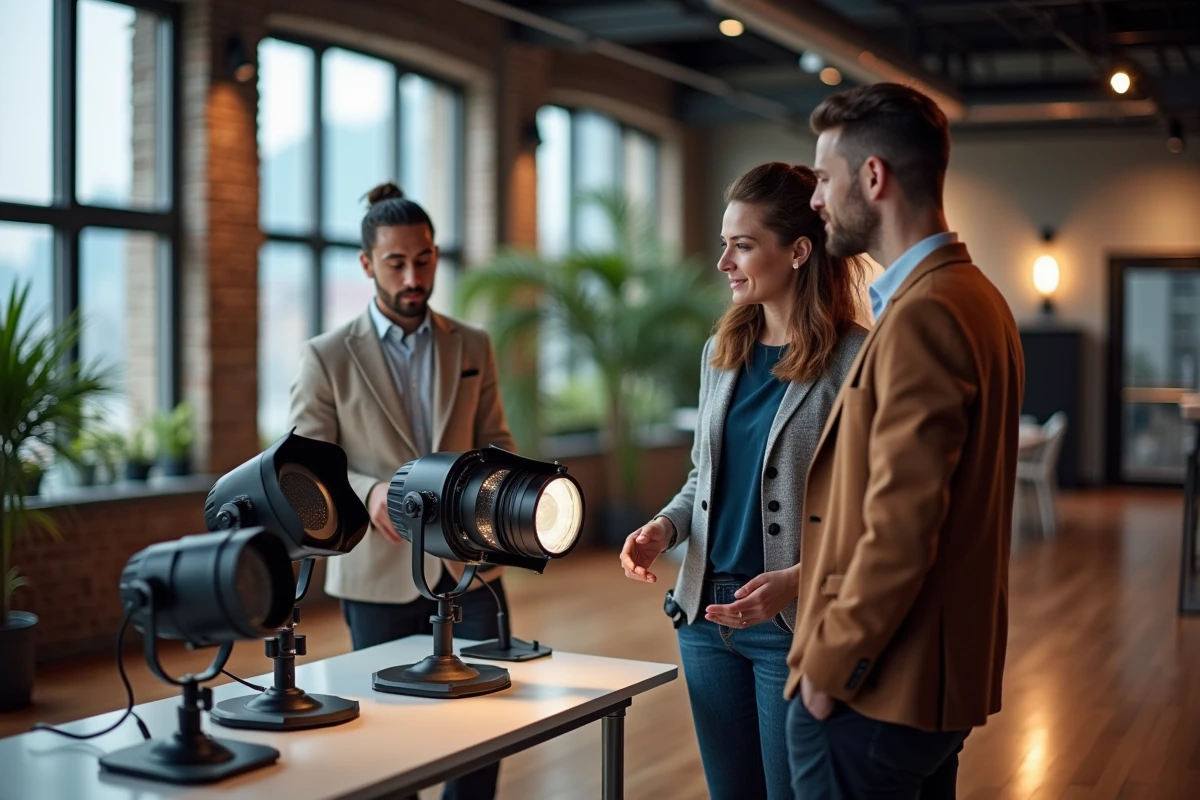
Here are the main types of stage spotlights to consider based on your needs:
- Moving head lights: perfect for dynamic effects, programmed transitions, and great staging flexibility, controlled by a DMX console.
- LED PAR lights: ideal for colorful effects, background lighting, or creating immersive atmospheres.
- Cutting spots: used to focus light on an artist, a specific object, or an area to highlight.
- Blinders and strobe lights: create visual bursts, peaks of intensity, and particularly memorable moments.
LED technology, with its multi-LED chips, covers the entire RGB spectrum and the purest cold white. For a concert, a conference, a wedding, adapt the type of spotlight to the ambiance to be created, the surface to be illuminated, and the need for static or dynamic effects. Mastering DMX control remains the key to impeccable synchronization between light and the rhythm of the event.
Practical tips for successfully lighting your event
Successfully lighting an event requires method and anticipation. Start by assessing the space, identifying constraints, and targeting the most suitable equipment for the venue’s configuration.
Choosing the color temperature is an essential step: favor warm light (2700-3200 K) to create a friendly or intimate atmosphere, or opt for neutral or cool shades (4000-6000 K) to energize a room or enhance the professional aspect of a conference. The color rendering index (CRI) ensures the accuracy of shades: a high CRI enhances decor, artworks, or products being showcased.
Managing the amount of light must be precise. Measure intensity in lux to effectively distribute spotlights, eliminate shadow areas, and maintain the audience’s visual comfort. LED equipment remains a preferred choice, both for limiting energy consumption and simplifying maintenance. IP65/IP67 models should be favored outdoors for their durability.
DMX programming allows for fine-tuning transitions and effects. For an ambitious event, hiring an experienced lighting technician ensures the coherence of light plays, safety, and management of unforeseen circumstances. Careful coordination between LED video walls and spotlights prevents overshadowing the stage or disrupting the overall visual balance.
Finally, adjust the budget to the nature of your event, the duration of use, and technical requirements. Investing in quality LED equipment often proves cost-effective in the long run due to superior lifespan and reduced maintenance needs.
At the intersection of technical constraints and creative ambitions, light becomes an accomplice of emotions. When well chosen, it transforms an ordinary event into a memorable experience, etched in memories long after the lights go out.