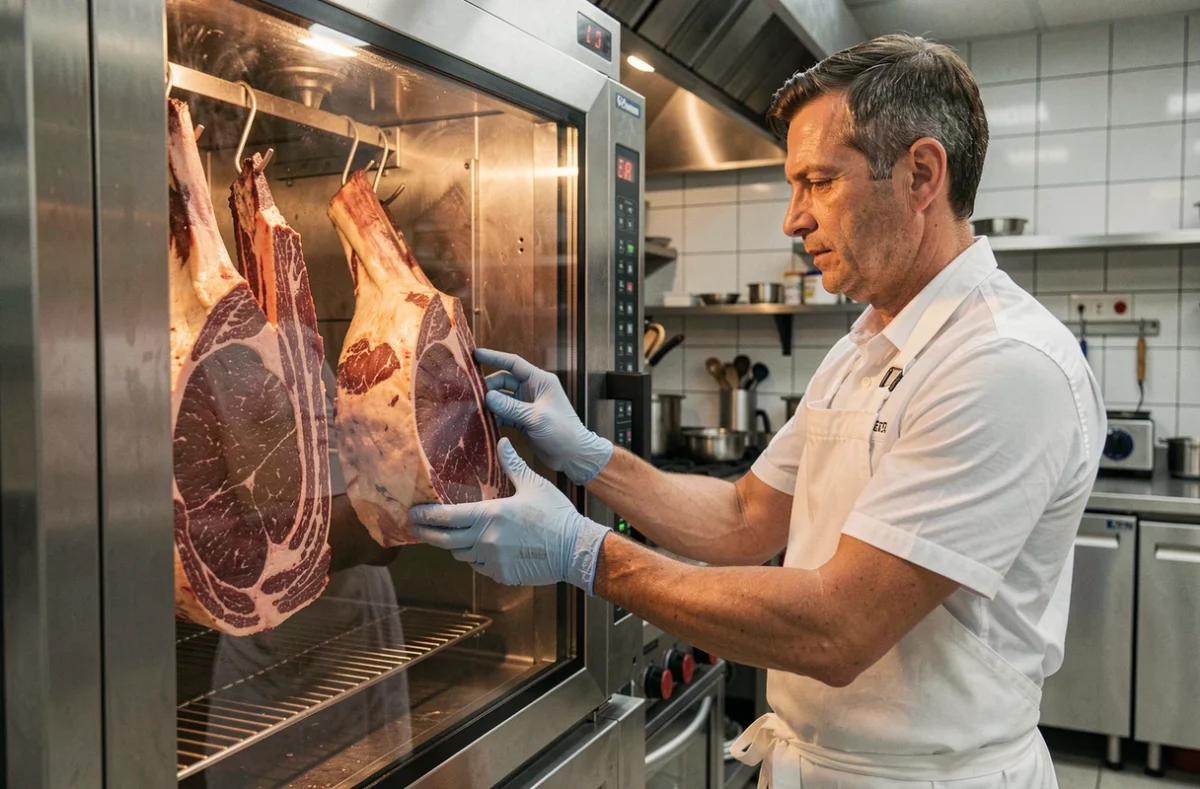
Choosing a maturation cellar involves balancing three physical parameters (temperature, relative humidity, air flow) and an often underestimated economic constraint: the yield loss associated with the dry aging process. The equipment alone guarantees nothing if the meat-setting combination is not coherent. This article compares the technical variables that separate a mediocre result from a successful maturation.
Yield Loss and Geometry of Cuts: The Forgotten Parameter
Most guides focus on the capacity in liters or the number of shelves. According to research by Teagasc, smaller and thinner cuts lose moisture much faster than larger pieces. A perfectly adjusted cellar will not prevent a thin ribeye from drying out beyond reasonable limits.
This observation has a direct consequence on the choice of equipment: the interior layout matters as much as the gross volume. A cellar with hanging hooks is better suited for large cuts (whole rib of beef, loin), while a model with spaced shelves adapts to smaller pieces, provided that ventilation circulates evenly around each cut.
Teagasc also emphasizes that dry aging reduces the sellable quantity due to evaporation and trimming of the crust. For a restaurateur or butcher, this cost must be weighed against the added flavor value. Investing in a high-performance meat maturation cellar is only justified if the final selling price absorbs this material loss.
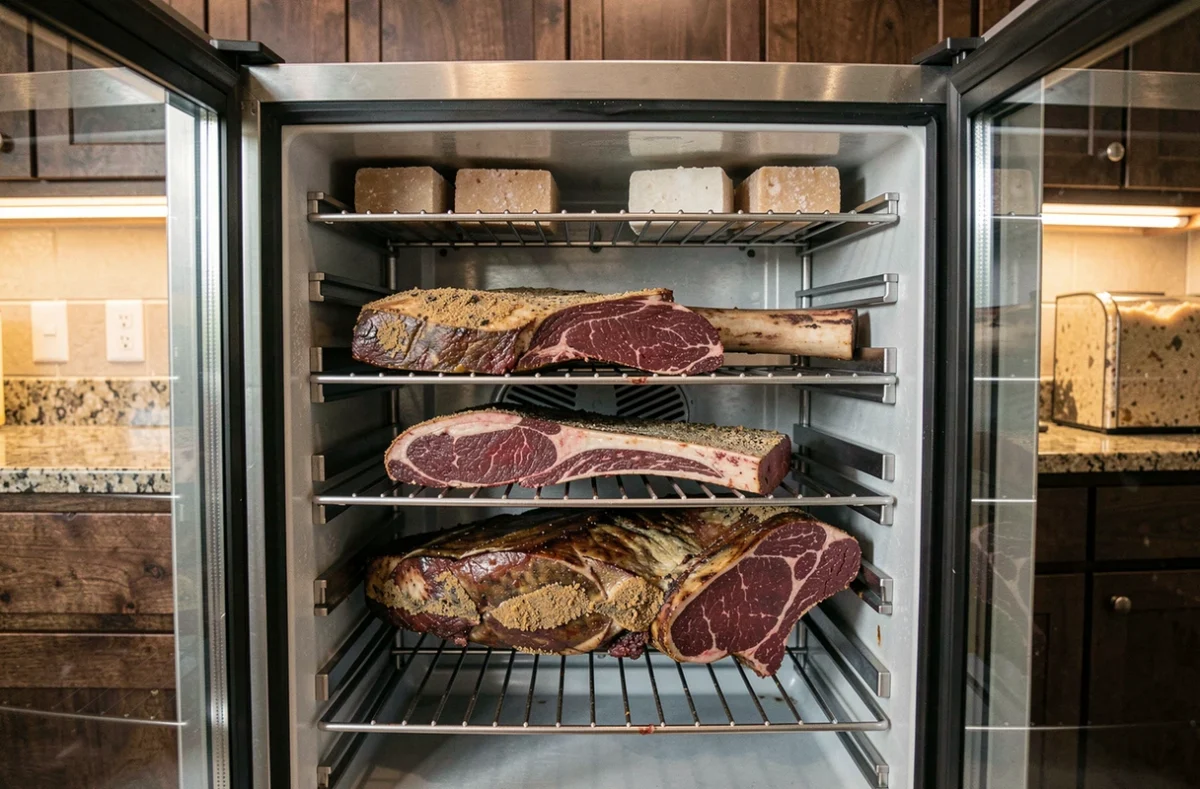
Temperature, Humidity, and Ventilation: Comparative Table of Critical Ranges
The three environmental parameters interact. Changing one without adjusting the others degrades the result, even compromising the product’s food safety.
| Parameter | Recommended Range (dry aging) | Risk if Too Low | Risk if Too High |
|---|---|---|---|
| Temperature | Close to 0 to 4 °C | Partial freezing, inactive enzymes | Rapid bacterial proliferation |
| Relative Humidity | Around 75-85 % | Excessive drying, thick crust | Undesirable mold, slimy texture |
| Ventilation | Constant and uniform flow | Stagnant zones, irregular maturation | Accelerated surface drying |
This table highlights a point that product sheets overlook: stability matters more than the exact value. A cellar that regularly fluctuates by several degrees with each compressor cycle poses more problems than a unit that is set half a degree above the target but remains perfectly stable.
Hygrometric Regulation: What Distinguishes a Reliable Cellar
Entry-level models rely on a passive water tray to maintain humidity. More advanced cellars incorporate an active hygrometric regulation system (sensor + controlled humidifier). The difference is noticeable in long maturations, where a humidity gap of a few points accumulated over several weeks profoundly alters the final texture.
Air filtration plays a complementary role. An activated carbon filter limits cross odors and reduces the ambient microbial load. Without this filter, meats absorb volatile compounds present in the chamber, which alters the expected aromatic profile.
Food Safety and HACCP Approach: A Selection Criterion for Professionals
Buying a cellar does not exempt one from documenting the process. For any food operator, sanitary control relies on procedures based on HACCP principles, not just on the quality of the equipment. A high-end cellar installed without a temperature logging protocol or cleaning plan does not meet regulatory obligations.
When choosing, three functions facilitate compliance:
- An integrated data logger that retains the history of temperatures and humidity, accessible in case of a health inspection
- A sound or connected alarm that signals any threshold exceedance, allowing intervention before the cold chain is broken
- Food-grade stainless steel inner walls, smooth and without corners, easy to clean without complex disassembly
These elements are not always included in consumer technical sheets. They make the difference between equipment suitable for regular professional use and a model designed for occasional use.
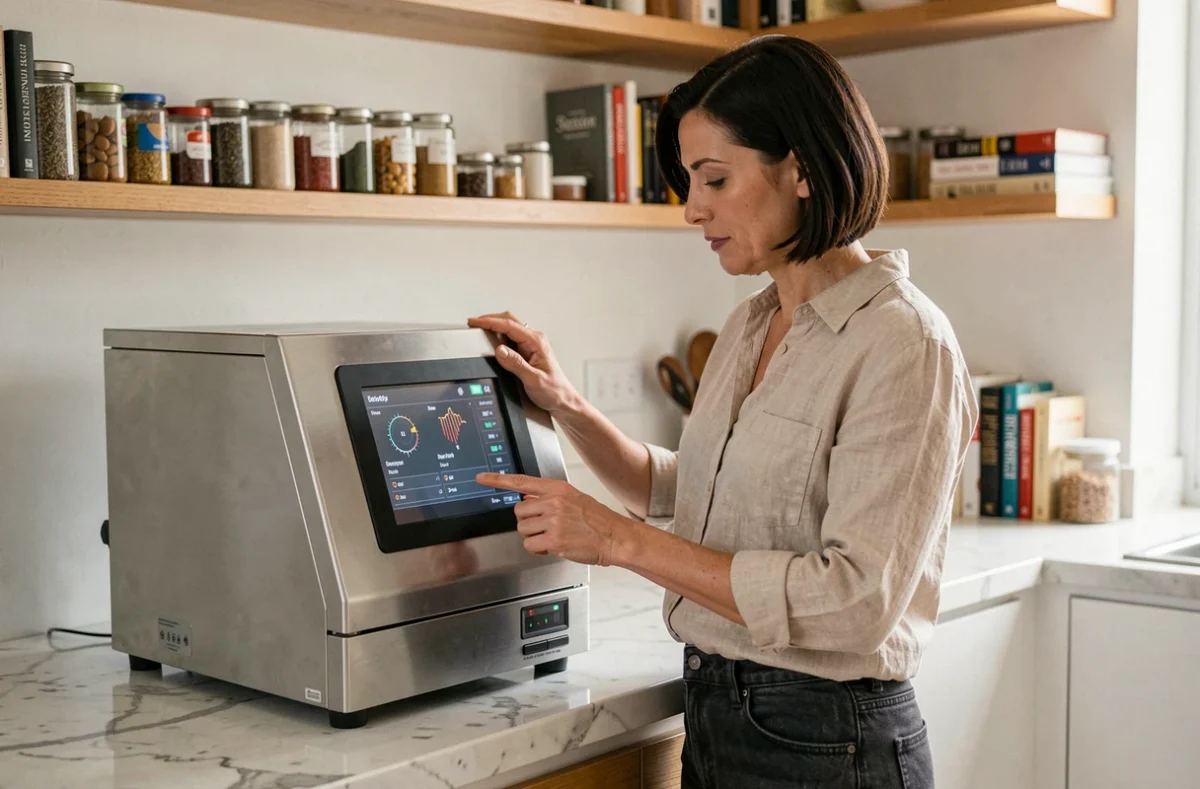
Tropicalized Models and Installation Environment
The compressor of a maturation cellar is sized for a given ambient temperature range. A standard model may lose performance in a hot professional kitchen, where room temperature regularly exceeds the thresholds set by the manufacturer. So-called tropicalized models are designed to operate in warmer environments without the compressor running continuously.
The location plays a direct role in electricity consumption and the longevity of the cooling unit. Placing the cellar away from heat sources (oven, sink) and in a ventilated space reduces mechanical stress. A detail that impacts the energy bill over several years of operation.
Glass Door or Solid Door: A Trade-off Between Visibility and Insulation
The glass door, often highlighted for its showcase aspect, allows more calories to pass through than an insulated solid door. In a restaurant where the cellar is exposed in the dining area, the visual effect is justified. In a butchery lab, a solid door offers better thermal insulation and reduces compressor cycles.
The choice between visibility and thermal performance thus depends on the installation location and commercial objective. Displaying aging cuts in front of customers enhances the product. Keeping them in a technical space prioritizes the consistency of the process.
The data that truly conditions the choice remains the ratio between material loss (evaporation, trimming) and the resale price of the aged product. Without this prior calculation, the investment in a high-performance cellar risks never being amortized, regardless of the quality of the flavors obtained.